
The virtual moving estimate that drives itself to the house.
A virtual moving estimate replaces the estimator visit with a 5-minute phone walkthrough. Your customer films each room; HomeSurvey's AI returns a quote-ready cube sheet — cubic feet, weight, cartons, voice-note exclusions — in under 30 minutes. $20 per survey, first 10 free.
Start 10 free surveys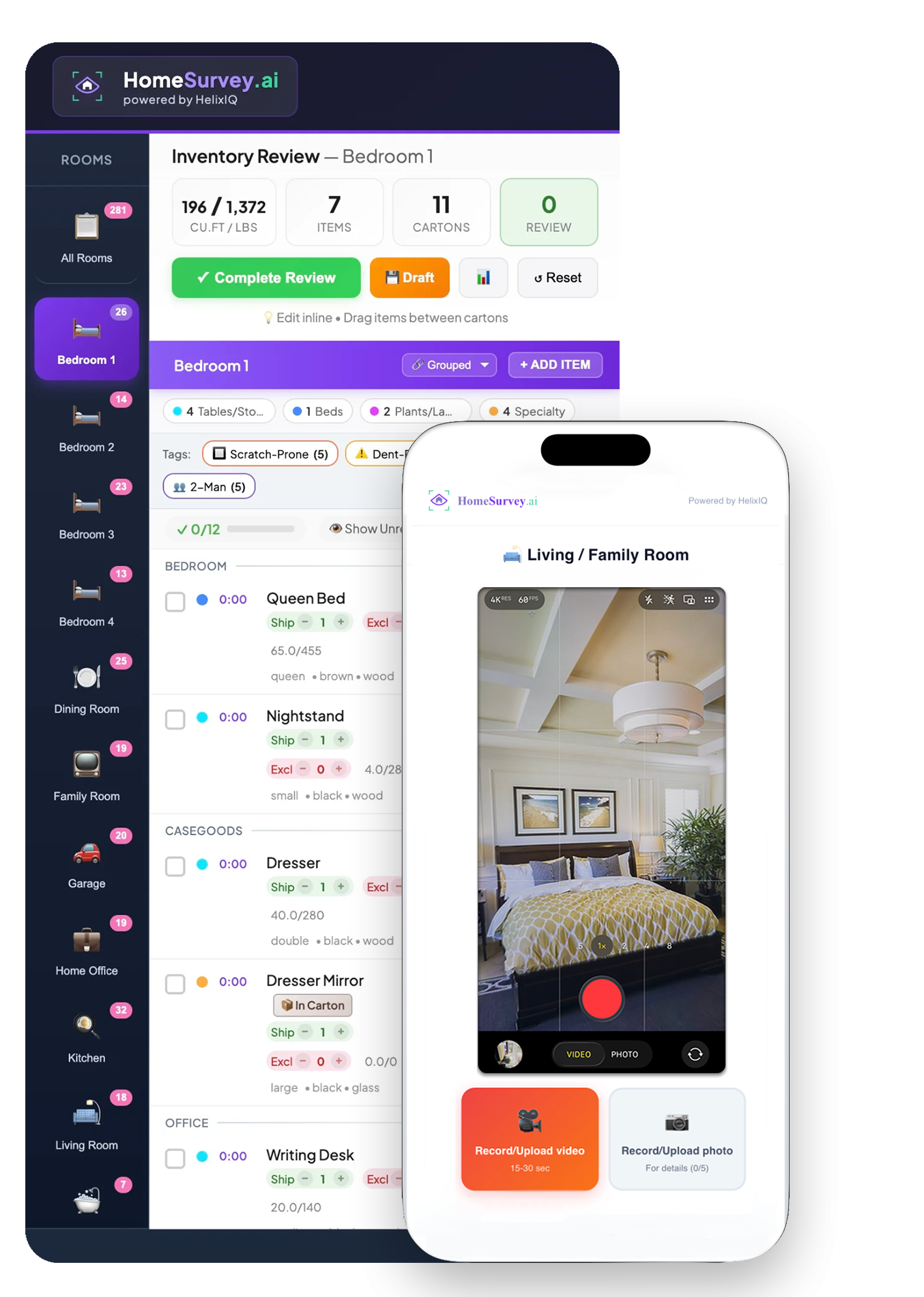
What is a virtual moving estimate?
A virtual moving estimate is a moving quote produced without sending an estimator to the home. The customer records a short video walkthrough on their own phone — no app, no scheduling — and the moving company builds the inventory and price from that footage. With AI processing, what used to take a two-hour visit plus drive time becomes a 30-minute, fully remote workflow: link out, walkthrough in, cube sheet ready.
The estimate itself is built from the same evidence an estimator would collect in person — every room on video, every special item narrated by the customer — which is why accuracy holds at 93% versus van-line bills of lading.
How a virtual moving estimate works.
Text the link
Send a branded survey link by SMS or email straight from your dashboard. The customer starts whenever suits them — evenings, weekends, lunch breaks.
Customer films 5 minutes
Guided room-by-room capture in the mobile browser. Voice notes like "the lamp goes to my mom's" are transcribed and auto-excluded from the estimate.
AI returns the estimate
2,000+ item types detected, weights and volumes assigned, cartons counted. Your rep reviews a quote-ready cube sheet — not a blank spreadsheet.
The questionnaire fills itself.
Say “two flights of stairs” or “piano in the den” on video, and the AI answers your custom questionnaire. Works with customer phone videos and estimator walkthroughs with Ray-Ban Meta AI glasses. Your rep reviews before anything goes out.
AI glasses are not included. HomeSurvey.ai works with Ray-Ban Meta AI glasses, sold separately.
What your customer sees.
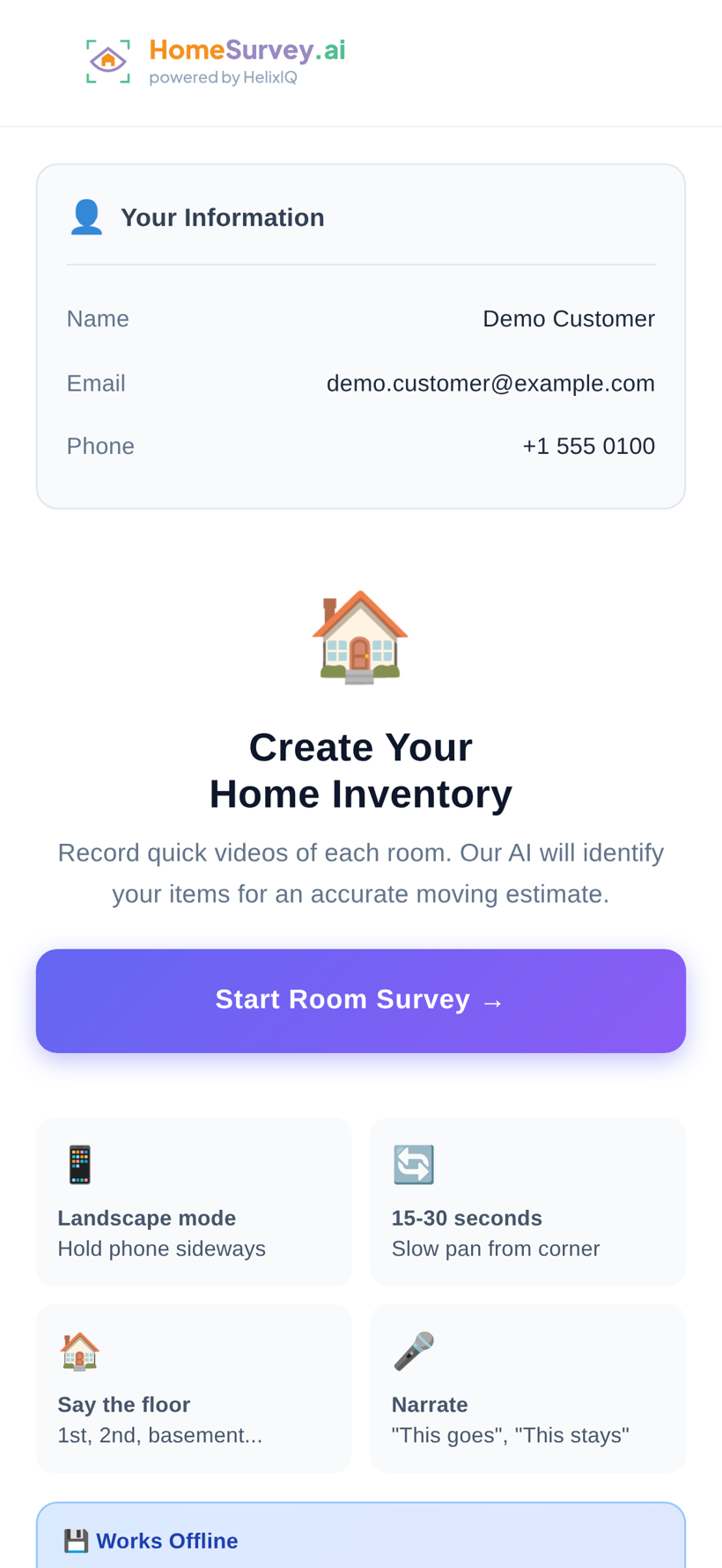 Taps the linkNo app, no account — opens right in the browser
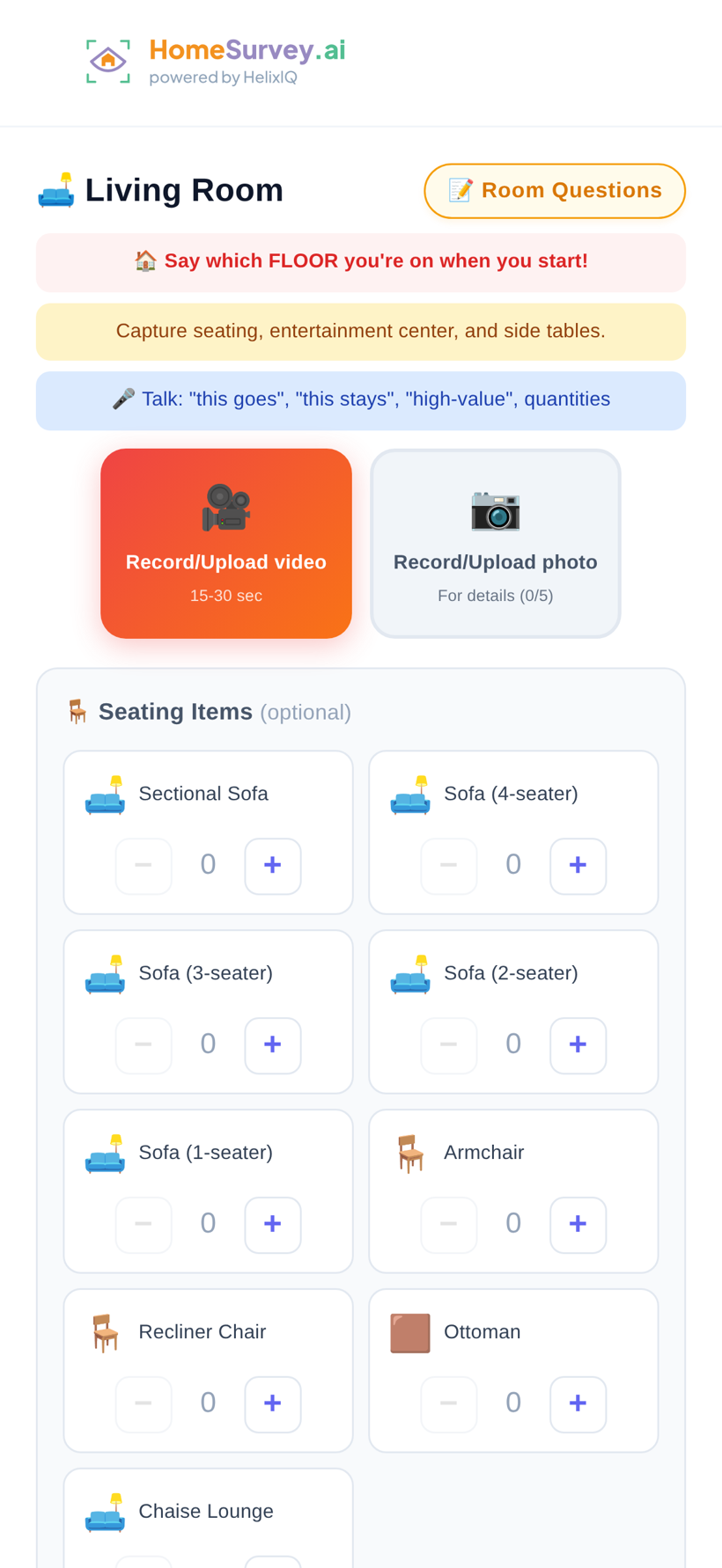 Films each roomGuided prompts; the AI tallies the items
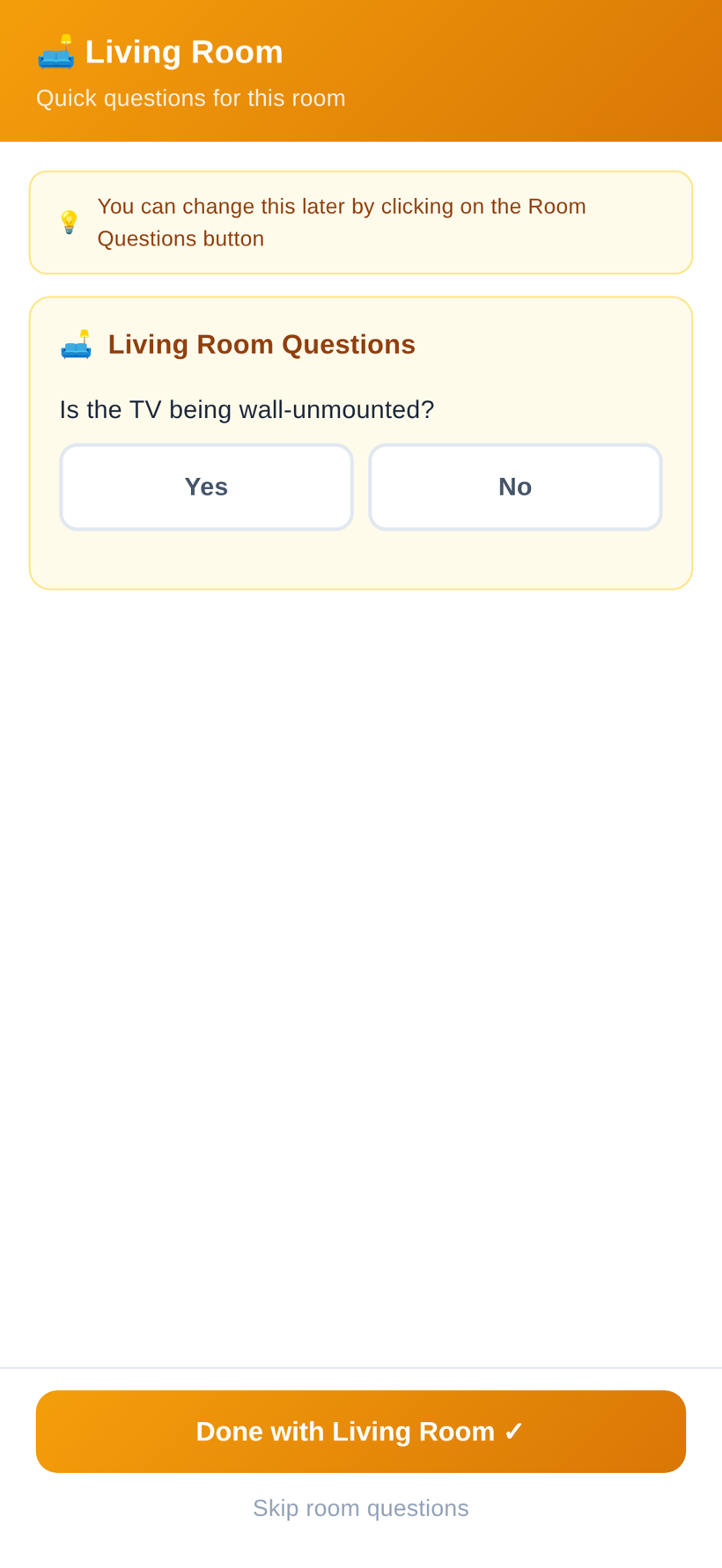 Answers smart questionsCatches the details estimators miss
What's inside a virtual moving estimate.
A virtual moving estimate isn't a rough phone guess — it's the same priced cube sheet a senior estimator would hand you after an in-home visit, only built from the customer's own walkthrough. Every estimate returns a room-by-room inventory across 2,000+ recognized item types, cubic feet and estimated weight per item and per room, carton counts by size, flagged special-handling items (pianos, gun safes, marble tops, oversized art), and the voice-note exclusions the customer narrated out loud.
Because every line traces back to the exact frame of video it came from, your rep reviews and adjusts a finished estimate instead of keying one from a blank sheet — and the customer receives a quote built on evidence, not a number pulled over the phone.
Virtual estimate vs. in-home estimate: the math.
In-home: $75–$150 per visit
Estimator wage, vehicle, fuel, and a two-hour window — spent whether or not the lead closes. Drive time caps throughput at 4–6 estimates per day.
Scheduled surveys: 35–40% ghost
Every no-show is a sunk visit cost and a stalled lead. Async virtual estimates remove the appointment entirely — completion runs above 90%.
Virtual: $20, quote 15–20/day
Five to six virtual estimates for the price of one in-home visit — and the same rep quotes 15–20 jobs a day instead of 4. Run your numbers →
Virtual, in-home, and phone estimates compared.
| Virtual estimate · HomeSurvey.ai | In-home estimate | Phone estimate | |
|---|---|---|---|
| Cost per estimate | $20 | $75–$150 loaded | ~$0 |
| Turnaround | Under 30 minutes | 2 hrs + drive time | 10–15 minutes |
| Built from | Video of every room | Estimator's in-person look | Customer's memory |
| Inventory accuracy | 93% vs van-line BOL | Varies by estimator | Lowest — guesswork |
| Estimates per rep / day | 15–20 | 4–6 | 15–20 |
| Evidence for disputes | Video per line item | Estimator's notes | None |
| Customer scheduling | None — async, anytime | Appointment required | Live call required |
A phone estimate is fast and free but rests on what the customer remembers; an in-home estimate is thorough but slow and expensive. A virtual moving estimate captures the same evidence as an in-home visit at phone-estimate throughput — which is why it has become the default for residential lead qualification.
Try it on your next 10 leads — free.
An estimate that defends itself on move day.
Video evidence per line item
Every item in the estimate links to its source frame. Disputed quote? Rewind the walkthrough — weeks later, if needed.
Voice-note exclusions
"The piano stays." Transcribed, flagged, excluded — automatically. The estimate reflects what's actually moving, not what was visible.
Move-Day Audit closes the loop
Crew re-scans on move day; AI flags every added item and weight variance against the estimate — recovering ~$750 per residential move on average. How audits work →
A three-bedroom move, quoted in 26 minutes.
A residential lead comes in Friday at 6 p.m. — historically the kind of lead that waits until Monday for an estimator to call back. Instead, your dashboard texts a survey link. The customer films their three-bedroom home over the weekend: living room, three bedrooms, kitchen, garage, and a "the treadmill is staying" voice note in the spare room.
Twenty-six minutes after they hit submit, your rep opens a finished estimate: 1,180 cubic feet, ~8,260 lbs, 41 cartons, a flagged 65" TV for wall-unmounting, and the treadmill already excluded. The rep adjusts two line items, applies your tariff, and sends the quote — before a competitor relying on an in-home visit has even returned the call. One $20 survey replaced a $120 visit and a two-day delay, and the video stays on file if anything is questioned on move day.

Planning a move yourself?
Virtual estimates aren't just better for movers — they're better for you. No stranger in your home, no two-hour appointment, and a quote built from video evidence instead of a guess.
Ask your moving company if they quote with HomeSurvey.ai — or point them to this page.
Which moves are a fit for a virtual estimate?
Residential & local
The clearest win. Qualify every residential lead virtually before committing an estimator's day to it. Residential moves →
Interstate & long-distance
Weight drives the price on van-line moves, so the 93%-accurate cube sheet matters most here — and the video defends that weight if it's ever questioned. Virtual vs in-home →
Commercial & military
Office and government moves with strict documentation needs get a time-stamped video record and an itemized inventory by default. Military & gov't →
The exception is the rare ultra-high-value or highly complex home, where a hybrid still makes sense: qualify virtually first, then send an estimator only when the job warrants it.
Quote your next 10 leads virtually — free.
No card, no contract, no demo gate. See how virtual estimates compare to in-home estimates head-to-head, or read the 2026 virtual moving survey guide.
Start 10 free surveys